TL;DRHigher success with fewer LLM calls更高成功率,更低调用成本
Anti-Persistence helps agents use past experience more effectively without updating model weights: it retains trajectories and outcomes over the long term, generates guidance as needed for the current task, and discards that guidance after use. Across nine settings spanning three models and three benchmarks, it achieves higher average held-out success with fewer LLM calls than the three memory baselines.Anti-Persistence 在不更新模型权重的前提下,让 agent 更有效地利用历史经验:长期保留 trajectory 与结果,针对当前任务按需生成 guidance,用后即丢弃。在三个模型、三个 benchmark 的九种配置中,相比三种 memory 对照方案,它以更少的 LLM 调用,取得更高的平均 held-out 成功率。
Trajectory memory: 53.5%比最强 memory 对照高 6.4%
Trajectory memory:53.5%
3 models × 3 benchmarks与另外七种方法比较
3 个模型 × 3 个 benchmark
9.5–10.2 calls per task低于三种 memory 对照方案
对照:每个任务 9.5–10.2 次
Averages weight all nine settings equally. +6.4% is the absolute success-rate difference (59.9% − 53.5%). Calls include guidance synthesis and task execution. See the full comparison →均值按九种配置等权计算。+6.4% 为成功率绝对差值(59.9% − 53.5%);调用数包含 guidance synthesis 与任务执行。查看完整对比 →
For each task, the system uses past feedback to choose how to draw on experience: consult previous execution records directly, extract useful action steps from successful runs, build an overall plan from successful runs, or derive corrective advice from failed runs. It also considers the extra LLM calls needed to generate guidance. That guidance is discarded after the task, while execution records and outcomes remain available for future tasks.系统根据当前任务与历史反馈,选择如何利用经验:直接参考过去的执行记录、从成功记录中提取操作步骤、从成功经验中归纳整体计划,或从失败记录中总结纠错建议。选择时还会考虑生成 guidance 所需的额外 LLM 调用。生成的 guidance 在任务结束后即丢弃,执行记录与结果则继续保留,供后续任务参考。
01Error reproduction: how mistakes enter memory againError Reproduction:错误如何再次进入 memory
Consider a hypothetical example: an agent finds a cup in a cabinet and records “check the cabinet first” as a required step for getting a cup. On the next task, the cup is already on the table, yet the agent checks the cabinet before picking it up. The task succeeds, and the unnecessary check becomes part of a successful execution record. If the system treats every step in that record as part of what made the task succeed, it may generate new guidance that again requires checking the cabinet first.假设 agent 曾在橱柜里找到杯子,便把“先检查橱柜”记成了拿杯子的固定步骤。下一次任务中,杯子已经在桌上,它仍先检查橱柜,再去拿杯子。任务虽然完成了,多余的检查步骤也留在了这次成功的执行记录里。如果系统把这些步骤都当作成功经验,新生成的 guidance 就可能再次要求“先检查橱柜”,让同一个错误借助新记录继续保留下来。
The paper distinguishes error propagation from error reproduction. Propagation occurs when an existing faulty record or rule is retrieved and reused. Reproduction occurs when a faulty rule shapes later execution and those trajectories are distilled into new faulty rules. Deleting the original rule alone cannot remove its influence from the trajectories already stored or from rules derived from them.论文将这一问题区分为 error propagation 与 error reproduction。前者是已有错误记录或规则被检索并复用;后者是错误规则影响后续执行,受影响的 trajectory 又被归纳为新的错误规则。仅删除原始规则,无法同时清除它对已有 trajectory 的影响,也无法删除由这些记录衍生的规则。
Persistent abstractions持久化 abstraction
- Infer a rule归纳规则May overgeneralize from limited experience可能把局部经验过度泛化
- Reuse it later跨任务复用The rule shapes new actions规则影响新的行动
- Keep the trajectory保留执行记录Its influence enters execution records影响被写入执行经验
- Synthesize again再次归纳The same error may reappear同类错误可能再次出现
Anti-PersistenceAnti-Persistence
- Keep execution records保留执行经验Store trajectories and outcomes存储 trajectory 与结果
- Retrieve for this task针对当前任务检索Choose a mode and relevant records选择模式与相关记录
- Use fresh guidance使用临时 guidanceSynthesize only when selected按所选模式进行 synthesis
- Discard the guidance用后丢弃 guidanceSave the new execution and outcome保存本次执行及其结果
This distinction matters when maintaining memory. Removing a questionable rule prevents its direct retrieval, but does not automatically revise executions produced under that rule. A maintenance policy can still help by examining those records or filtering later abstractions. The design question is therefore both what to retain and how long inferred guidance should remain reusable.这一区分也解释了 memory 维护的难点。删除可疑规则,可以阻止它被直接检索,却不会自动修正此前受其影响的执行记录。维护策略仍可通过检查这些记录或筛选后续 abstraction 发挥作用。因此,memory 设计既要回答保留什么,也要回答生成的 guidance 应当在多长时间内继续被复用。
02Separate persistent experience from temporary guidance区分长期经验与临时 guidance
To limit the direct reuse of rules, Anti-Persistence manages long-term records separately from guidance for the current task. The experience store retains task trajectories and outcomes. A separate outcome log records mode choices and their results, including a cost penalty for extra synthesis calls. Generated guidance is written to neither store and is discarded when the task ends.为限制规则的直接复用,Anti-Persistence 将长期保存的记录与面向当前任务的 guidance 分开管理。Experience store 保存任务 trajectory 和结果;独立的 outcome log 记录模式选择及其效果,并计入额外 synthesis 调用的成本惩罚。生成的 guidance 不写入这两类存储,任务结束后即被丢弃。
- Retrieve feedbackFind outcomes from similar earlier tasks.检索历史反馈获取相似任务的执行结果。
- Choose a modeDecide how to use past experience.选择使用模式决定如何利用历史经验。
- Execute the taskUse retrieved records or newly generated guidance.执行当前任务使用检索到的记录或新生成的 guidance。
- Update the execution recordsSave trajectories and outcomes; discard generated guidance.更新经验记录保存 trajectory 与结果,丢弃生成的 guidance。
Four modes for using memory四种 memory 使用模式
None · use trajectories directlyNone · 直接使用 trajectory
Retrieve past trajectories without an extra synthesis call. “None” means no synthesis, not no memory.直接检索历史 trajectory,不进行额外的 guidance synthesis。None 表示不执行 synthesis,而非不使用 memory。
Imitation · reuse an action patternImitation · 复用行动模式
Extract useful action patterns and the conditions under which they worked from successful runs.从成功的 trajectory 中提取可复用的行动模式及其适用条件。
Strategic · generate a high-level planStrategic · 生成高层计划
Use successful runs to identify higher-level subgoals and a plan for the new task.基于成功的 trajectory,确定当前任务的高层子目标与执行计划。
Corrective · generate corrective guidanceCorrective · 生成纠错 guidance
Analyze failed runs and, when available, compare them with a successful run to produce corrective guidance.分析失败的 trajectory,并在有可用成功样本时进行对照,生成纠错 guidance。
Choose how to use memory, then retrieve the records先选 memory 的使用方式,再取相关记录
The system first uses feedback from similar past tasks to choose how to use memory. It then retrieves relevant execution records, either to use directly or to generate guidance for the current task. Each new task outcome informs future choices, without updating the model’s weights.系统先参考相似任务的历史反馈,选择 memory 的使用方式;再检索对应的执行记录,直接用于当前任务,或从中生成 guidance。新的任务结果会为后续选择提供依据,整个过程无需更新模型权重。
03A full comparison across models, tasks, and memory designs不同模型、任务与 memory 设计的完整对比
The study evaluates three fixed backbones × three benchmarks, comparing Anti-Persistence with four agent baselines and three other memory configurations. Each method receives the same iteration-task stream. Only these episodes update memory; after each of ten rounds, the entire held-out set is evaluated with memory and controller state frozen. Held-out logs never enter later updates.实验覆盖三个固定 backbone × 三个 benchmark,将 Anti-Persistence 与四种 agent baseline、三种其他 memory 配置比较。各方法使用相同的迭代任务序列,只有这些 episode 可以更新 memory。每轮更新后,在冻结 memory 与 controller 状态的条件下评测完整 held-out 集,共进行十轮;held-out 日志不参与后续更新。
ALFWorld
Multi-step actions in household environments家庭场景中的多步操作
180 iteration tasks · 134 held-out tasks180 个迭代任务 · 134 个 held-out 任务
WebShop
Product search and selection under explicit constraints满足明确约束的商品搜索与选择
200 iteration tasks · 100 held-out tasks200 个迭代任务 · 100 个 held-out 任务
ScienceWorld
Interactive science tasks交互式科学任务
150 iteration tasks · 60 held-out tasks150 个迭代任务 · 60 个 held-out 任务
Each round samples 50 iteration tasks; the backbone weights remain fixed. Main results report mean ± standard deviation across three seeds. See Appendix D.1.每轮抽取 50 个迭代任务,backbone 权重始终固定。主实验报告三个随机种子的均值 ± 标准差。详见附录 D.1。
From overall averages to nine individual settings从总体均值展开到九种具体配置
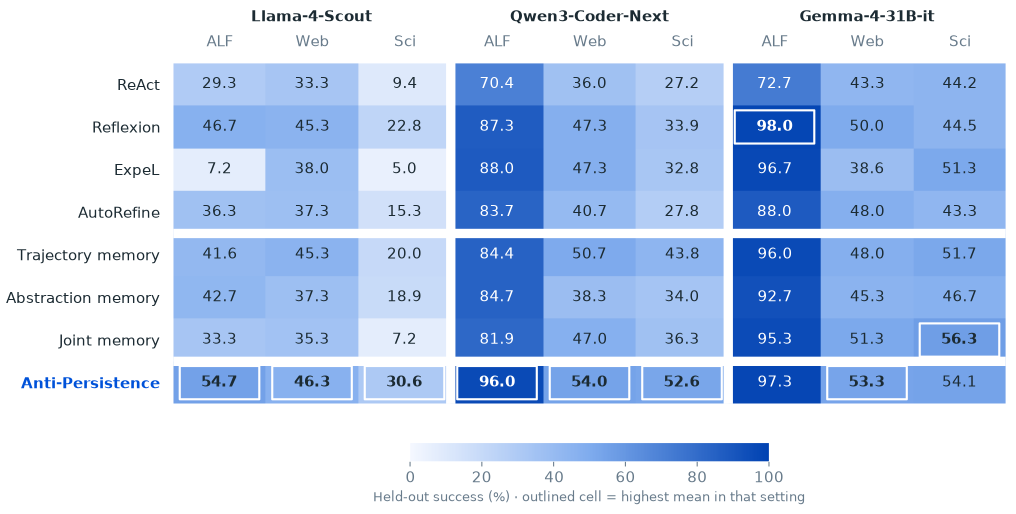
Anti-Persistence reaches the highest mean in seven of nine settings. It outperforms trajectory memory and abstraction memory in all nine, and joint memory in eight. The gains are not confined to one backbone: on ScienceWorld, success rises from 20.0% to 30.6% for Llama and from 43.8% to 52.6% for Qwen when moving from trajectory memory to Anti-Persistence.Anti-Persistence 在九种配置中的七种取得最高平均成功率;相较 Trajectory memory 与 Abstraction memory,九种配置均有提升,相较 Joint memory 则在八种配置中更好。收益并不限于单个 backbone:在 ScienceWorld 上,从 Trajectory memory 切换到 Anti-Persistence 后,Llama 的成功率由 20.0% 升至 30.6%,Qwen 则由 43.8% 升至 52.6%。
Inspect all means and standard deviations展开查看完整均值与标准差
Llama-4-Scout
| Method方法 | ALFWorld | WebShop | ScienceWorld |
|---|---|---|---|
| ReAct | 29.3 ± 3.1 | 33.3 ± 1.2 | 9.4 ± 1.0 |
| Reflexion | 46.7 ± 6.1 | 45.3 ± 4.2 | 22.8 ± 1.0 |
| ExpeL | 7.2 ± 3.2 | 38.0 ± 5.3 | 5.0 ± 1.9 |
| AutoRefine | 36.3 ± 3.2 | 37.3 ± 2.3 | 15.3 ± 1.7 |
| Trajectory memory | 41.6 ± 1.7 | 45.3 ± 1.2 | 20.0 ± 1.7 |
| Abstraction memory | 42.7 ± 1.2 | 37.3 ± 1.2 | 18.9 ± 1.0 |
| Joint memory | 33.3 ± 2.3 | 35.3 ± 1.2 | 7.2 ± 1.9 |
| Anti-Persistence | 54.7 ± 2.9 | 46.3 ± 1.8 | 30.6 ± 1.0 |
Qwen3-Coder-Next
| Method方法 | ALFWorld | WebShop | ScienceWorld |
|---|---|---|---|
| ReAct | 70.4 ± 1.8 | 36.0 ± 2.0 | 27.2 ± 2.6 |
| Reflexion | 87.3 ± 3.1 | 47.3 ± 1.2 | 33.9 ± 3.5 |
| ExpeL | 88.0 ± 2.0 | 47.3 ± 2.3 | 32.8 ± 4.8 |
| AutoRefine | 83.7 ± 6.7 | 40.7 ± 2.3 | 27.8 ± 1.0 |
| Trajectory memory | 84.4 ± 2.6 | 50.7 ± 1.2 | 43.8 ± 3.7 |
| Abstraction memory | 84.7 ± 2.4 | 38.3 ± 3.5 | 34.0 ± 1.0 |
| Joint memory | 81.9 ± 0.2 | 47.0 ± 1.7 | 36.3 ± 0.6 |
| Anti-Persistence | 96.0 ± 1.4 | 54.0 ± 2.0 | 52.6 ± 1.5 |
Gemma-4-31B-it
| Method方法 | ALFWorld | WebShop | ScienceWorld |
|---|---|---|---|
| ReAct | 72.7 ± 1.2 | 43.3 ± 2.3 | 44.2 ± 1.2 |
| Reflexion | 98.0 ± 0.8 | 50.0 ± 2.0 | 44.5 ± 2.6 |
| ExpeL | 96.7 ± 2.3 | 38.6 ± 1.9 | 51.3 ± 1.2 |
| AutoRefine | 88.0 ± 4.0 | 48.0 ± 4.0 | 43.3 ± 0.0 |
| Trajectory memory | 96.0 ± 1.0 | 48.0 ± 0.2 | 51.7 ± 1.7 |
| Abstraction memory | 92.7 ± 2.3 | 45.3 ± 4.2 | 46.7 ± 1.7 |
| Joint memory | 95.3 ± 3.1 | 51.3 ± 1.2 | 56.3 ± 2.4 |
| Anti-Persistence | 97.3 ± 1.2 | 53.3 ± 3.1 | 54.1 ± 6.3 |
Success (%), mean ± SD over three seeds. Source: paper Table 1.成功率(%),三个随机种子的均值 ± 标准差。来源:论文表 1。
Generating guidance need not increase total LLM calls生成 guidance,不一定增加总调用次数
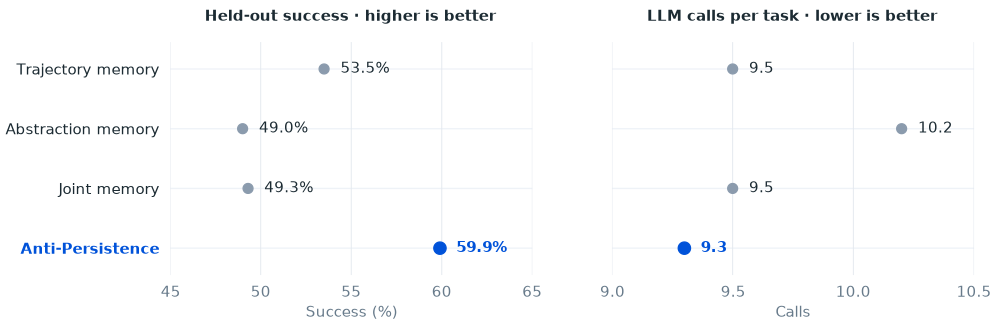
On average, Anti-Persistence improves success by 6.4% over Trajectory memory while reducing LLM calls from 9.5 to 9.3.平均而言,Anti-Persistence 相比 Trajectory memory 的成功率提升 6.4%,调用次数则由 9.5 降至 9.3。
Reported gains use % for absolute differences between success rates, rather than relative percentage growth.文中增益以 % 表示成功率的绝对差值,而非相对增长率。
04How memory behaves over ten rounds十轮更新中,memory 的作用如何变化?
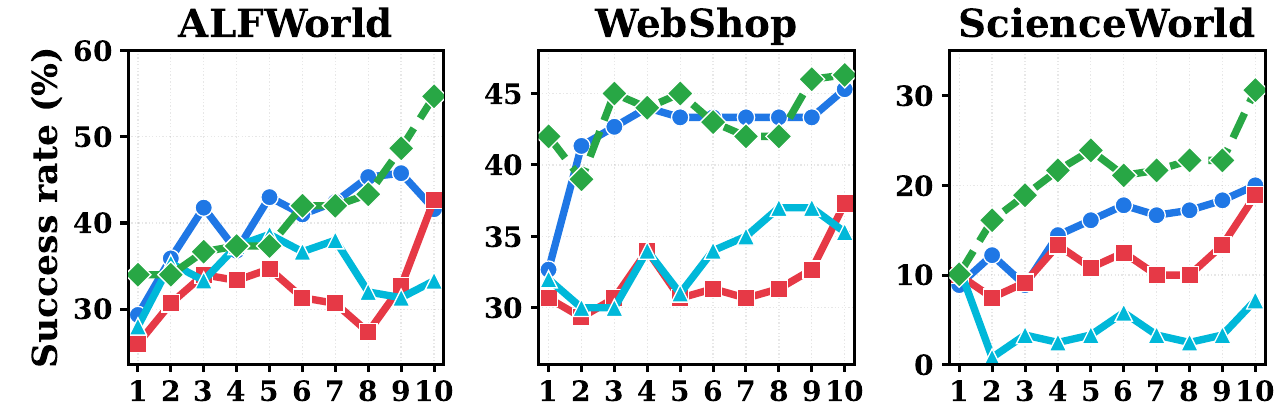
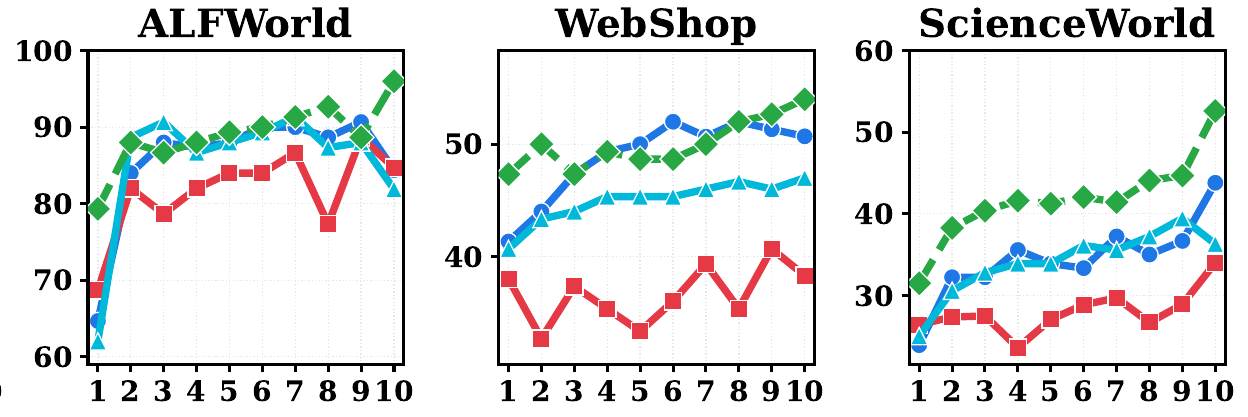
The iteration curves below compare the four memory configurations while keeping the backbone fixed. Switch models to inspect the same three benchmarks under different backbones.下方曲线在固定 backbone 的条件下比较四种 memory 配置;切换模型,可以查看相同三个 benchmark 在不同 backbone 上的变化。
Llama-4-Scout
Qwen3-Coder-Next
Gemma-4-31B-it
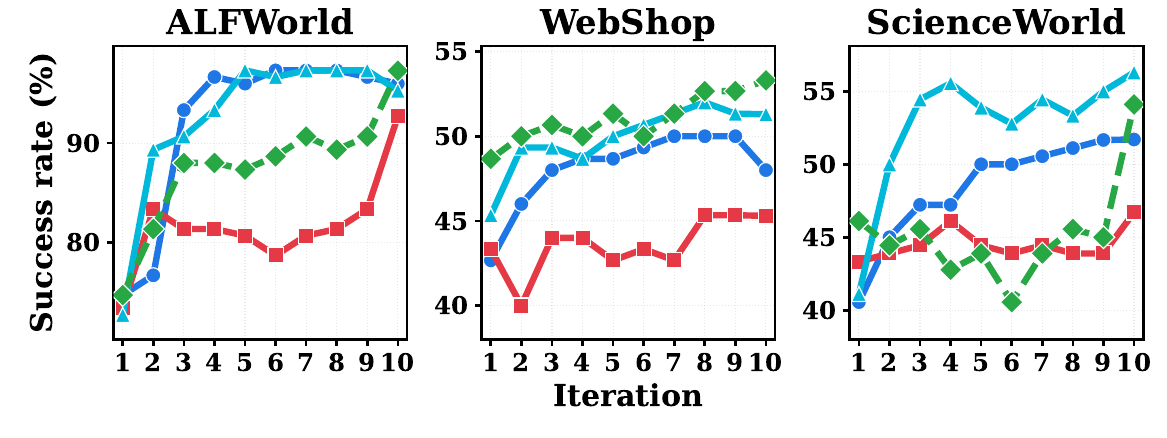
What to look for如何阅读这些曲线
- Llama: joint memory loses ground late in the run, especially on ScienceWorld.Llama:Joint memory 在后期出现回落,ScienceWorld 尤为明显。
- Qwen: abstraction memory fluctuates substantially on WebShop. Anti-Persistence ends ahead across all three benchmarks, without leading at every intermediate round.Qwen:Abstraction memory 在 WebShop 上波动较大。Anti-Persistence 在三个 benchmark 的最终均值均更高,但并非每轮都领先。
- Gemma: joint memory finishes best on ScienceWorld, while Anti-Persistence leads the other two benchmarks among the four memory designs.Gemma:Joint memory 在 ScienceWorld 上最终表现最好,Anti-Persistence 则在另外两个 benchmark 的四种 memory 设计中领先。
05Which design choices account for the gains?哪些设计选择带来了收益?
The paper examines three choices separately: whether to save generated guidance, how to choose a mode for using experience, and how many records to retrieve. Each experiment changes one of these choices and measures task success.论文将方法拆成三个选择分别考察:生成的 guidance 要不要保存、如何选择经验的使用模式,以及每次检索多少条记录。每组实验调整其中一个选择,再比较任务成功率。
1. Should guidance be discarded after use or saved?1. Guidance 用完后,应该丢弃还是保存?
Both variants retain trajectories and task outcomes, and both can generate guidance for the current task. The comparison concerns what happens afterward: Discard removes that guidance after use; Persist saves it for retrieval in later tasks.两个版本都保留 trajectory 与任务结果,也都可以为当前任务生成 guidance。区别在任务结束后:Discard 丢弃这份 guidance;Persist 将它保存下来,供后续任务检索。
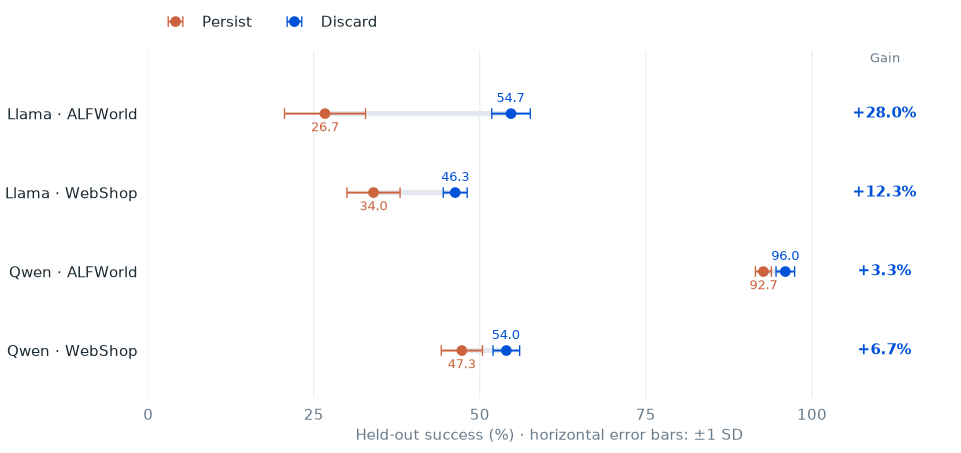
Discard has higher mean success in all four settings. For example, Llama-4-Scout on ALFWorld reaches 54.7% with Discard, versus 26.7% with Persist. In these settings, keeping execution records while discarding generated guidance works better than retaining both.四种配置中,Discard 的平均成功率均更高。例如,在 Llama-4-Scout 的 ALFWorld 实验中,Discard 为 54.7%,Persist 为 26.7%。这说明,在这些配置下,保留执行记录、用后丢弃 guidance,比把生成的规则也长期保存下来更有效。
Inspect retention-ablation values查看保留策略消融的完整数值
| Model / benchmark模型 / benchmark | Discard guidanceDiscard guidance | Persist guidancePersist guidance | Change (%)变化(%) |
|---|---|---|---|
| Llama-4-Scout · ALFWorld | 54.7 ± 2.9 | 26.7 ± 6.1 | +28.0 |
| Llama-4-Scout · WebShop | 46.3 ± 1.8 | 34.0 ± 4.0 | +12.3 |
| Qwen3-Coder-Next · ALFWorld | 96.0 ± 1.4 | 92.7 ± 1.2 | +3.3 |
| Qwen3-Coder-Next · WebShop | 54.0 ± 2.0 | 47.3 ± 3.1 | +6.7 |
Source: paper Table 2. Success rates are percentages, reported as mean ± standard deviation over three seeds. Change is the absolute difference: Discard minus Persist.来源:论文表 2。成功率以 % 标注,报告三个随机种子的均值 ± 标准差。变化为绝对差值:Discard 减去 Persist。
2. Should the agent use one fixed mode or choose per task?2. 使用固定模式,还是根据任务动态选择?
This experiment compares three policies: always use one synthesis mode (Imitation, Strategic, or Corrective), choose randomly, or use the adaptive Bandit to choose based on the current task and past feedback. The bar chart compares their success rates; the heatmap shows which modes the adaptive selector actually uses.这组实验比较三种方式:始终使用某一种模式(Imitation、Strategic 或 Corrective)、随机选择,以及由自适应 Bandit 根据当前任务和历史反馈选择。柱状图比较成功率;热图展示自适应 selector 实际使用了哪些模式。
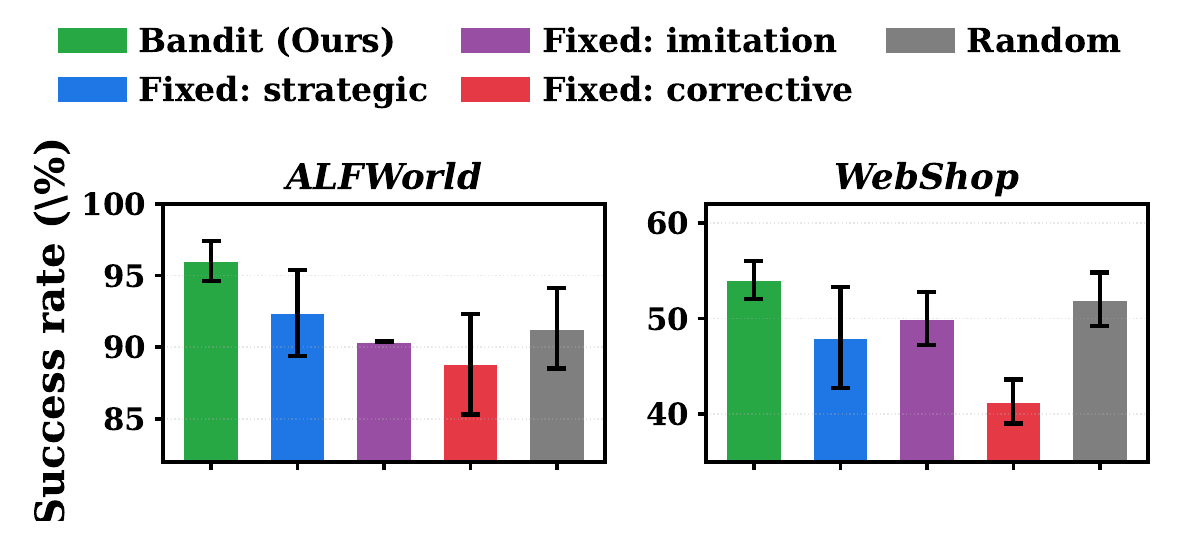
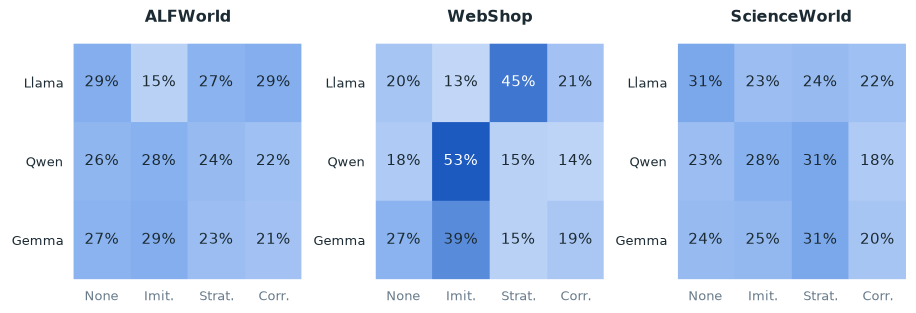
Adaptive selection has the highest mean success on both benchmarks. With Qwen3-Coder-Next, it reaches 96.0% on ALFWorld and 54.0% on WebShop. The best fixed mode changes across benchmarks: Strategic on ALFWorld, Imitation on WebShop. These comparisons support adapting mode choice to the task and feedback.自适应选择在两个 benchmark 上的平均成功率均最高。在 Qwen3-Coder-Next 上,ALFWorld 为 96.0%,WebShop 为 54.0%。最佳固定模式则随 benchmark 改变:ALFWorld 是 Strategic,WebShop 是 Imitation。这组对比支持根据任务与反馈调整模式。
Mode preferences vary across models. On WebShop, Qwen selects Imitation most often (53% on average), whereas Llama favors Strategic (45%). Every setting also includes some use of None, where the agent reuses trajectories directly without generating additional guidance.不同模型呈现出不同的模式偏好。在 WebShop 上,Qwen 最常选择 Imitation(平均占比 53%),Llama 则最常选择 Strategic(45%)。各配置中也有部分任务采用 None,直接复用 trajectory,无需额外生成 guidance。
3. Does retrieving more records always help?3. 每次检索的记录越多,效果就越好吗?
The system retrieves two kinds of records: detailed execution histories to help perform a task, and feedback on earlier mode choices to help select a mode. The plots vary how many records are retrieved for each purpose:系统会检索两类记录:一类提供任务的具体执行过程,另一类提供模式选择后的效果反馈。下图分别考察这两类记录的检索数量:
- B controls how many trajectories are retrieved to help perform the task. Each trajectory records how a past task was carried out. Once a mode is selected, the system retrieves relevant trajectories to use directly or to generate guidance.B 控制执行任务时检索多少条 trajectory。每条 trajectory 记录过去一次任务的具体执行过程。模式确定后,系统取出相关记录,直接供 agent 参考,或据此生成 guidance。
- controls how many feedback records inform mode selection. Each record describes which mode was used for a similar task and how it performed. The selector uses this feedback to choose how to use memory for the current task. 控制选择模式时参考多少条历史反馈。每条反馈记录相似任务采用了哪种模式、效果如何。Selector 据此判断当前任务适合哪种 memory 使用模式。
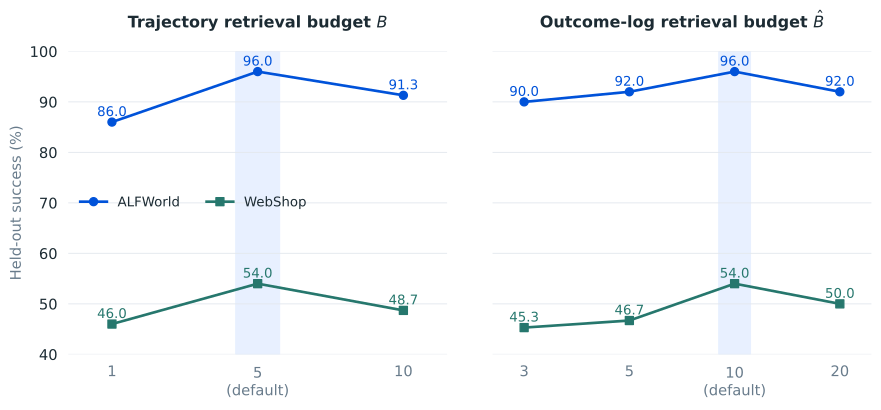
Among the tested values, B = 5 and = 10 give the highest mean success on both benchmarks. For WebShop in the left panel, increasing B from 1 to 5 raises success from 46.0% to 54.0%; increasing it further to 10 lowers success to 48.7%. Retrieving more records does not keep improving performance.在所测取值中,B = 5、 = 10 在两个 benchmark 上的平均成功率均最高。以左图的 WebShop 为例,B 从 1 增加到 5 时,成功率从 46.0% 升至 54.0%;继续增加到 10,反而降至 48.7%。增加检索数量并没有持续带来收益。
06Should useful abstractions be kept long term?有用的 abstraction,是否应该长期保留?
Two auxiliary experiments compare how supplied skill content and selective retention affect task success.两组辅助实验分别比较 skill 内容与筛选保留策略对任务成功率的影响。
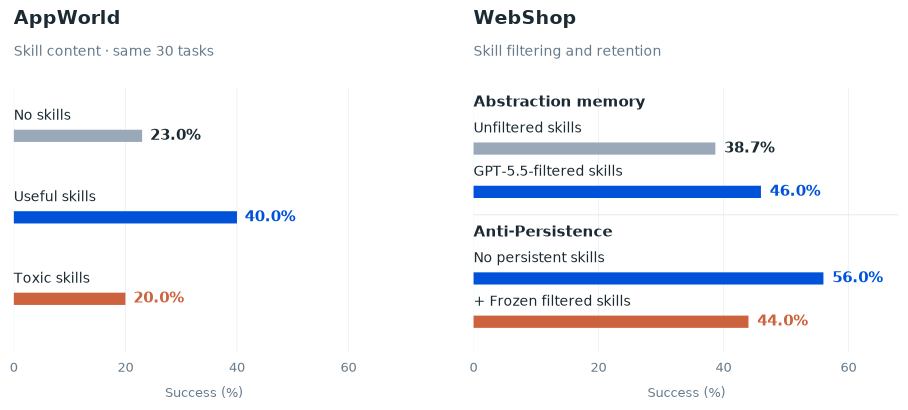
Guidance can be useful. On AppWorld, useful skills improve aggregate success from 23.0% to 40.0%, while toxic skills give 20.0%.Guidance 本身可以有用。在 AppWorld 上,有用 skill 将总体成功率从 23.0% 提升至 40.0%,错误 skill 对应 20.0%。
Filtered skills have different effects in the two memory configurations. In Abstraction memory, GPT-5.5 screens each newly generated skill to decide whether it should be stored, raising success from 38.7% to 46.0%. In Anti-Persistence, the filtered skills are added as an extra persistent memory layer that remains fixed during evaluation; success falls from 56.0% to 44.0%.筛选后的 skill 在两种 memory 配置中带来了不同结果。在 Abstraction memory 中,每条新生成的 skill 先由 GPT-5.5 筛选,再决定是否存入 memory,成功率从 38.7% 升至 46.0%。在 Anti-Persistence 中,筛选后的 skill 被作为额外的持久化 memory 层加入,并在评测期间保持固定,成功率从 56.0% 降至 44.0%。
Useful guidance can improve task performance, while retaining filtered skills can still reduce it. These results support Anti-Persistence’s choice to generate guidance as needed and discard it after use.有用的 guidance 能提升任务表现,但筛选后长期保留仍可能降低效果。这些结果支持 Anti-Persistence 按需生成 guidance、用后丢弃的设计。
07Key takeaways要点总结
- More memory does not guarantee better performance. Errors in stored guidance can shape later actions and be distilled again from new execution records, allowing the same mistake to persist across tasks.更多 memory 不一定带来更好的表现。存入 memory 的错误 guidance 可能影响后续执行,并通过新的执行记录再次被归纳出来,让同一错误在任务之间延续。
- Keep execution records and generate guidance for the current task. Anti-Persistence retains trajectories and outcomes, generates guidance when needed, and discards it after use. This lets later tasks draw on accumulated memory without directly reusing stored guidance.保留执行记录,按当前任务生成 guidance。Anti-Persistence 保留 trajectory 与任务结果,在需要时生成 guidance,用后丢弃。后续任务仍能利用积累的 memory,同时避免直接复用已存储的 guidance。
- Adapt how memory is used. The selector uses feedback from similar tasks to choose between direct trajectory reuse and different forms of guidance, accounting for the extra LLM calls needed to generate that guidance.根据任务选择 memory 的使用方式。Selector 参考相似任务的历史反馈,在直接复用 trajectory 与生成不同形式的 guidance 之间选择,同时考虑生成 guidance 所需的额外 LLM 调用。
- Higher success with fewer LLM calls. Anti-Persistence achieves higher success in most evaluated settings while reducing the average number of LLM calls.成功率更高,LLM 调用更少。Anti-Persistence 在多数实验配置中取得更高的成功率,同时降低平均 LLM 调用成本。
08Citation引用
@article{wang2026antipersistence,
  title   = {More Memory, Worse Agents: Error Reproduction
             and Anti-Persistence in LLM Agents},
  author  = {Wang, Ruhan and Panaganti, Kishan and Zhou, Dongruo},
  journal = {arXiv preprint arXiv:2610.27406},
  year    = {2026},
  url     = {https://arxiv.org/abs/2610.27406}
}